Christopher Nolan’s epic new film, The Odyssey, is the first Hollywood movie to be filmed entirely in Imax, the Canadian-rooted large-format film technology that’s world-famous for its fill-your-peripheral-vision immersive theatre experience.
Already being touted as Nolan’s best, the film also contains a poignant personal touch: at its world première in London, Nolan announced he’s dedicating The Odyssey to his “friend and Imax mentor David Keighley,” who died last September and who – alongside his wife, Patricia Keighley – oversaw Imax’s quality control for more than 40 years.
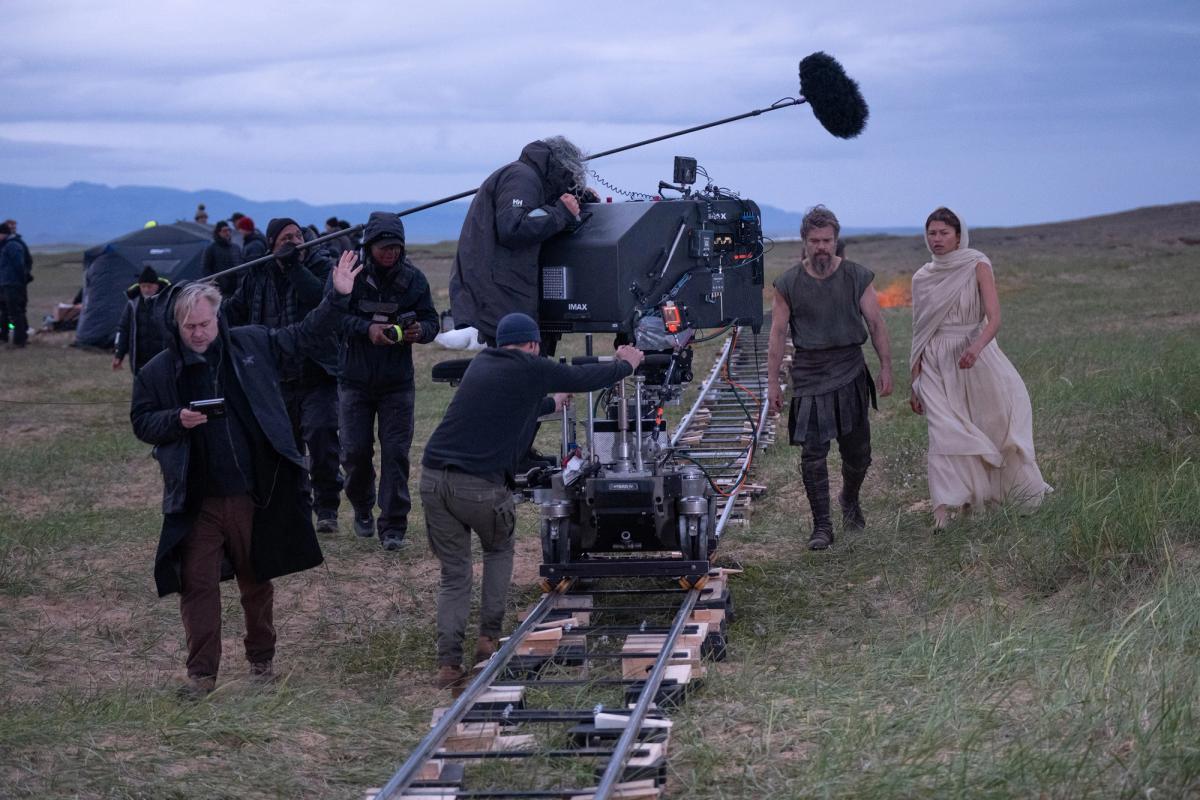
As well, Imax’s next-generation film camera – its first new film-camera system in years – has been christened “the Keighley camera.” Nolan was the first to use it, taking the camera on an epic journey through eight countries and across all sorts of terrain while filming The Odyssey to elevate the Hollywood spectacle to Imax-sized proportions. The story behind the new camera is one of friendship, ingenuity and perseverance, much like the movie itself.
Who are David and Patricia Keighley?
Officially, David was Imax’s chief quality officer, while Patricia continues today as its chief quality guru; unofficially, they’re known as the guardians of the Imax experience. The Toronto-born pair fell in love with Imax while on an afternoon date to see North of Superior at Ontario Place’s Cinesphere back in 1971. David was a recent grad of the photographic arts program at Ryerson Polytechnical Institute (now called Toronto Metropolitan University) and immediately knew he wanted to work in this new large film format.
The following year, the couple founded David Keighley Productions (DKP), a large-format post-production company, and co-directed their first Imax film, Catch the Sun, which featured fast-paced vignettes of Ontario life, including a speedboat skimming Ottawa’s Rideau Canal and a front-seat roller-coaster ride.
The Keighleys have worked on every Imax film since, supervising post-production of nearly 500 movies, officially joining the company in 1988. They went on to shepherd Imax’s filmmaking evolution from niche documentaries to must-see global blockbusters – including The Odyssey. No film left the lab without David’s approval, and he was determined to complete the processing and printing of Nolan’s raw footage, known as “dailies,” even after his diagnosis of terminal cancer.
David and Patricia’s son Geoff wrote on Instagram that his dad thought “The Odyssey would be ‘the most important movie ever made’ in his 53-year career.” In his post, the younger Keighley described how his parents shared Nolan’s dream to make a film entirely with Imax cameras, “‘Our Lawrence of Arabia,’ as he liked to say.”
David received his cancer diagnosis just days before principal photography began, and Geoff wrote that his dad’s desire to see The Odyssey completed carried him through.
“Every morning, my mom and dad sat together in a screening room in Hollywood, personally approving every single frame of more than two million feet of film shot by Chris and his team,” wrote Geoff. “As my dad grew weaker, he never wavered in his commitment to Chris and his wife/producing partner, Emma Thomas. And you know what? He did it. Like Odysseus, my dad made it home – he finished principal photography of the film.”
What’s special about the Keighley camera?
Nolan has used Imax cameras in all of his films since 2008’s The Dark Knight, the first narrative feature to film in the medium. It was while working on Oppenheimer that a long-standing Imax problem became impossible for Nolan and his cinematographer, Hoyte van Hoytema, to avoid: the cameras were just too loud.
Imax cameras use 65mm film (that is then projected in 70mm), which means the cameras need powerful motors and mechanics to handle its sheer size. Unlike traditional film cameras, which use glass plates to pinch the frames as each passes through the camera gate, Imax uses a vacuum system that “sucks” each frame flat against the gate as the frames whip through the machine at 24 frames per second, with each frame about the size of a credit card. (That’s 1,000 feet of film in three minutes, if you’re trying to do the math.) That’s the physics of large-format filmmaking, so if Nolan wanted to film an entire movie in Imax, something needed to change. Specifically, a quieter camera needed to emerge from Imax’s lab in Mississauga, Ont.
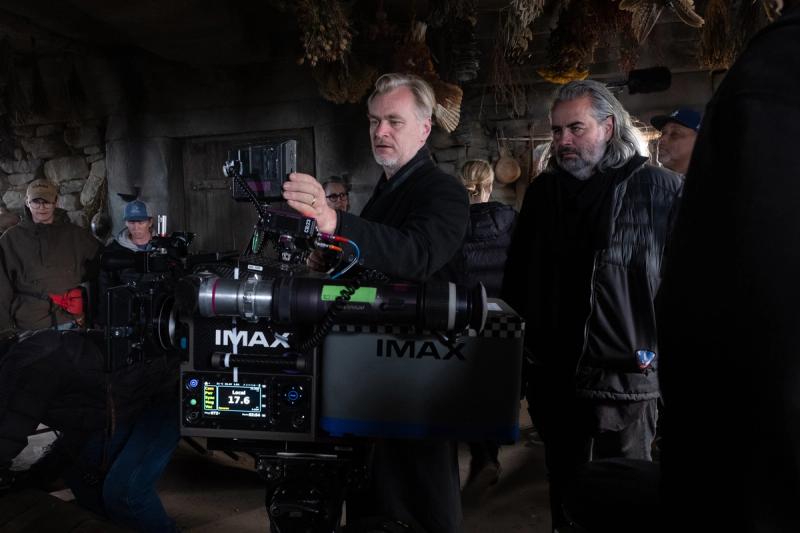
The result – the new Keighley camera – is smaller and quieter thanks to a carbon-fibre body and changes to its internal mechanics, which Imax claims reduce noise by up to 30 per cent. Van Hoytema describes it as the difference between “an unhinged lawnmower and a nicely lubricated sewing machine” in a recent Fast Company story.
The new camera has also evolved from physical knobs and dials to include Wi-Fi, Bluetooth, an LCD screen and 4K videotape, giving the crew a high-resolution live preview of the shot instead of the rough low-fidelity feed older Imax cameras offered.
“The really high-level objective was to try to make it feel like a modern camera but keep all of the legacy aspects and all the things that are great about Imax film together,” says Mississauga-based Paul Constantinou, Imax’s vice-president of hardware engineering, in a company-produced video short. “That was kind of the North Star.”
How did shooting in Imax affect Nolan’s approach to filmmaking?
From the opening aerial shot of the rooftops of Gotham in The Dark Knight through to Matt Damon’s return to Ithaca in The Odyssey, Nolan has worked closely with Imax, pushing the company to evolve the mechanics of filmmaking and film processing. For The Odyssey, Nolan used seven Imax cameras – two Keighley cameras and five older models – with the Keighleys shooting close to 15 per cent of the film, usually in places where the older models were too big and bulky, such as aboard Odysseus’s ship while out at sea.
As with all things Imax, the camera’s immense size dictates the pace at which Nolan, his crew and his actors work. Imax’s 65mm film runs through the camera sideways, with 15 perforations (or sprocket holes) per frame – far more than the four holes in standard film. That produces Imax’s famous “big picture” look, which is about 10 times larger than a standard movie frame, and is why Imax images are so sharp.
However, big frames take up space. Each Imax camera magazine – the container that holds the unexposed film stock – can only hold enough film for about three minutes of continuous shooting before needing to reload. That means Nolan doesn’t have the luxury of letting the camera run for a long, languid shot. Actor Tom Holland, who plays Odysseus’s son Telemachus, has said in media interviews that he at first thought Nolan didn’t like his performance because the director called “cut” so often.
How did the camera impact the actors’ creative process?
While the Keighley camera offers a massive improvement on noise, Imax’s Mississauga engineering crew also built an insulated acoustic housing – known as a “blimp” – that allowed Nolan and van Hoytema to film intimate scenes, such as those between Anne Hathaway’s Penelope and Damon’s Odysseus, which they hadn’t been able to do in previous films.
The blimp-encased Keighley weighs about 180 kilograms and required seven people to lift and carry it on-set; its size meant it was difficult for actors to play off one another and look into the lens. With smaller, more conventional equipment, an actor can be off-screen but press their face against the camera so their scene partner can be looking at them and the lens simultaneously. Since that wasn’t possible with such a large camera, David Keighley worked with Nolan to attach mirrors to the blimp so the actors could see each other’s faces without looking away from the lens.
“When we met with Hoyte at the end of production, he said that this box was the most essential piece of technology that we had on this movie,” says Constantinou. “That was an insane thing to hear.”
How did the Keighleys nurture Nolan’s passion for Imax technology?
Nolan’s love of Imax film began in much the same way the Keighleys’ did: by watching a documentary on a big, spherical Omnimax screen when he was a teenager. Why, he thought, isn’t Hollywood using this technology? At The Odyssey world première in London, Nolan recounted that he got his chance when he met David Keighley in 2006 at the city’s BFI Imax theatre, where the director “confessed [his] secret desire to shoot Hollywood films on Imax.”
At the time, Nolan was in London filming The Prestige, his Victorian-era supernatural thriller, and preparing for his second Batman film, The Dark Knight. He specifically wanted to know if he could convert Imax’s large-format film reels to 35mm, the size of standard movie-theatre screens.
Keighley lent him an Imax camera to test for a scene in The Prestige, in which star Christian Bale cuts his finger. The conversion worked, and Nolan, with the Keighleys’ help, would go on to make Hollywood history with The Dark Knight, the first blockbuster to be partially shot in Imax.
“[David] very gently and very skilfully brought me along and helped out,” Nolan said at The Odyssey’s world première – hosted at the very same theatre where he met Keighley all those years ago. “He and Patricia, between them and all the other folks at Imax over the years, allowed us to do more and more films this way.”
Get The Leap, our weekly newsletter featuring the people, places, and ideas that show where Canada is headed.