
As settings for a life-altering decision go, you could do a lot worse than Fogo Island.
Scott Stirrett’s moment of clarity came on its well-known Lion’s Den trail, on a gorgeous day this past May in Newfoundland and Labrador. With the stark beauty of the North Atlantic as a backdrop, Stirrett turned to social entrepreneur Zita Cobb – whose Shorefast Foundation he’d been working with as a consultant – and said out loud what he’d been mulling since he left his longtime job six months earlier. “I told her, ‘I want to buy a business,’” he recalls. “I’ll remember that hike for the rest of my life.”
That resolution sparked months of energizing, edifying and sometimes exhausting work to assemble Carrying Place Holdings, a search-and-acquisition firm led by one person – Stirrett – with one purpose – to buy a single strong Canadian business to run for the long haul.
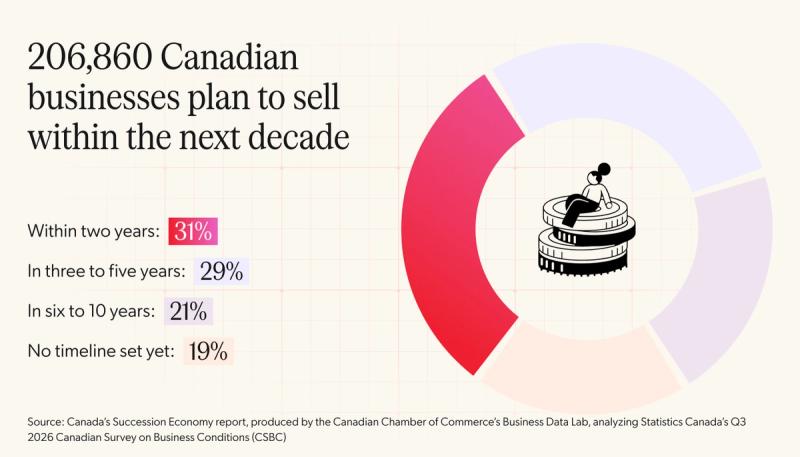
Stirrett’s timing couldn’t be better. In August, Statistics Canada reported that upward of 20 per cent of businesses in Canada plan to sell or transfer ownership in the next decade. A little more than a month later, the Canadian Federation of Independent Business (CFIB) reported that 63 per cent of small business owners intend to exit in the same time frame, with retirement the overwhelming motivator. Whatever way you slice it, more than 200,000 seasoned entrepreneurs want out of the game, and the businesses they’re looking to offload are valuable – a new analysis by the Canadian Chamber of Commerce’s Business Data Lab (BDL) found that 70 per cent of the companies entering succession turned a profit in each of the past three years, and their cumulative assets are worth trillions of dollars.

Get our new book for free.
Subscribe to our newsletter and we’ll mail you a printed copy.
In a world that valorizes inventors and disrupters, the appeal of an established business is often overlooked, but the fundamentals are hard to deny. “When you think about what’s often embedded in these businesses, it’s known stocks of human capital, customer relationships, supplier relationships, organizational knowledge, equipment and community trust,” says Marwa Abdou, an economist and the lead author of the BDL report on succession. “Many of them possess things that startups can spend years, and millions of dollars, trying to accumulate.”
Some of these businesses will be passed down to family members or sold to employees who’ve worked their way up. Some will scale down or shutter. But many others – more than half, by some estimates – will be sold to outsiders: to large multinationals, to other small and medium-sized enterprises, to investment groups or private equity firms or to individual buyers pursuing what’s known as entrepreneurship through acquisition, or ETA. “The business landscape really is poised for a dramatic shift,” says Laure-Anna Bomal, who co-authored this fall’s report from the CFIB, which has dubbed the situation a “succession tsunami.”
Count Stirrett among the growing ranks of ambitious young entrepreneurs who intend to ride the wave. But he’s under no illusions it’ll be an easy ride.
Stirrett is, in many ways, uniquely prepared to buy a business. He comes from a long line of merchants and entrepreneurs in Ontario and Nova Scotia, so he’s got clear eyes about the risks and realities. He took courses on entrepreneurship during his undergrad at Georgetown University’s School of Foreign Service in Washington, D.C., one of which centred on the frequently unglamorous but often lucrative upside of buying an established operation. And he has plenty of leadership experience under his belt, thanks to Venture for Canada (VFC), the national charity devoted to entrepreneurial skills development that Stirrett officially launched in 2014 after a year in New York with Goldman Sachs.
Notably, in his later years running VFC, Stirrett developed ETA Academy 101 and ETA Bootcamp – a pair of programs meant to teach Canadians how to acquire an established business – inspired by a suggestion from venture capitalist and then–VFC board member Wils Theagene. “There was, and is, a lot of programming about launching startups in Canada,” says Stirrett. “But at the time, there was almost nothing around training people to buy one.” In speaking with more than 100 business owners to help inform the new curriculums – and in getting to know dozens more who came in as instructors – Stirrett became intimately familiar with the ins and outs of acquisition, from debt financing to due diligence.
He started to wonder whether it was time to try it himself.
Stirrett’s decision to leave VFC was driven also by a growing sense of restlessness: “I like to learn, and I wanted a new challenge.” He didn’t want to rush into anything, so he travelled for a few months, then took on some consulting projects as he considered his options. It was through his work with Shorefast – which encourages the development of local towns and cities – that everything clicked. “It got me thinking about acquisition as an opportunity to meaningfully contribute to both Canada and to a local community,” he says. Hence, the Fogo epiphany.
Stirrett spent the better part of four months planning his strategy. He started by setting some principles to guide his hunt: he wanted a business he could manage and grow for the long haul, not an asset to run for a few years before flipping it; and he wanted to own as much of the equity as possible. Going forward as a “self-funded searcher” seemed the ideal path. (A self-funded searcher is often confused with a search fund, but the two are different: the latter typically involves multiple investors, often institutional, buying into one or both of two tranches of capital to access a relatively small share of ownership; and the former is more of a bootstrapped affair that gives the solo buyer most, if not all, of the spoils.)
Stirrett then set up some parameters for the business he’d like to buy. “If you just say, ‘I’m interested in anything,’ people don’t know what deals to send you,” he says, “and you don’t know where to focus your proprietary outreach.” He established criteria for location (roughly, Ontario and eastward, since both he and his husband have roots in Atlantic Canada), industry (generally, business-to-business service providers or specialized manufacturers, preferably those that serve the public sector or large institutions, a clientele Stirrett got to know well at VFC) and scale (ideally, operations generating between $1 million and $3.5 million in annual earnings before interest, taxes, depreciation and amortization, or EBITDA). And he didn’t want a fixer-upper. “I’m not looking to buy a distressed business. I’m looking to buy a business that is well run, that I can come in to and continually improve in the same way that the previous owner would probably have continued to improve it.”
This type of prep work requires both discipline and introspection, but it can increase the odds of a successful search, says Natalie Michael, the Vancouver-based managing partner of CEO Next Chapter, an advisory firm that helps leaders (including business owners) prepare for succession and buyers prepare to take over. “The clearer you are on your criteria and how you’re going to be able to create value based on what you bring to the table, the more likely you’ll get the kind of deal you want,” she says.
Only once Stirrett had done all that did he get into the practicalities. He set up a holding company and created a name, logo and website. He recruited a panel of advisers, mostly people he’d met in his career who he thought could help with the search. He set up software to keep track of conversations with owners and mergers and acquisitions advisers who might send potential deals his way. And he got his finances lined up: depending on the size of the company he ends up buying, Stirrett plans to fund it with a mix of personal and family capital, likely augmented with some senior debt (loans that are secured by collateral assets). Ideally, he’d secure a vendor take-back agreement, a common source of acquisition financing that has the seller lending the buyer funds for the transaction, typically between 10 per cent and 25 per cent of the purchase price.
It all meant that, by the time Stirrett published a LinkedIn post announcing his acquisition intentions, he was ready for whatever came next: “I was able to hit the ground running because I had a lot of the fundamentals already set up.”
It would seem, with all these Canadian business owners ready to bolt, that someone like Stirrett would have his pick of potential acquisitions. And if social media – including the #buyabusiness TikTok trend – is to be believed, obtaining a profitable operation is a smooth ride to easy money. But nearly three months into searching full-time, Stirrett is experiencing first-hand just how hard it really is. “Many people think it’s really easy to just swoop in and buy a good business,” he says. “But buying a good business at a fair price is very challenging.”
A big reason is that not every business that’s up for sale, or that may be soon, is well run or suited for succession by an outsider. Those that are generally have a lot of parties kicking the tires, including private equity and institutional investors with considerably more resources than someone attempting a solo bid. Many self-funded searchers come up short.
“The hard truth is that everybody really searches for the same things,” says Zack Belzberg, the president of Dodds Garage Door Systems – which he bought in 2017 and has since expanded to seven showrooms – and an adviser to Stirrett. (A stable business with reasonable cash flow at a fair price is kind of the ETA equivalent of a single-family home with great bones in a good school district.) “What distinguishes a successful searcher is realistic expectations of how long it takes and reasonable expectations of the quality of the assets available to them,” says Belzberg. “This is not for the faint of heart.”
Discipline is critical. Today, Carrying Place is a full-time pursuit for Stirrett, and he takes it very seriously. Thanks to his choice to be so public in his search, Stirrett’s phone keeps ringing. His LinkedIn announcement alone has led to multiple connections with potential acquisitions and investors. As a result, most days involve a packed schedule of researching companies, cold-emailing founders and meeting with owners and M&A brokers.

Whenever a prospect proves really promising – there are only a few at the moment – he shifts into initial due diligence. This involves sifting through financial statements, client lists and confidential information memorandums (documents typically prepared by external advisers that outline key details about a company’s market position, customer and supplier relationships, management team and more). Stirrett needs to watch for red flags, such as excessive customer concentration, poor financial performance or problematic legal or regulatory issues.
Once he gets to the letter-of-intent stage with a potential acquisition, Stirrett expects to work closely with legal and accounting experts on more intensive due diligence, including reviews of bank records and tax returns. It’s all meant to avoid the kind of horror stories that abound in the acquisition space – of a buyer finding that a principal customer has no interest in dealing with new owners, for example, or of a longtime second-in-command quitting and taking invaluable institutional knowledge with them.
Stirrett has brought in an intern to help manage the volume, and he’s planning to build a team of them. “It’s really busy,” he says. “You have to be very efficient with your time.” But for a self-funded searcher like Stirrett – even one with a network many would-be entrepreneurs would kill for – passivity isn’t an option. “If you’re not putting yourself out there, if you’re not actively screaming from the rooftops that you’re searching to buy a business, it’s a lot harder to be successful,” he observes.
Stirrett has no strict timeline to lock in his acquisition. He’d love to get a deal done in a year or two, but he’s willing to take longer if need be. “I’ve been given advice to not set a firm deadline but to act with a constant sense of urgency,” he says. “So I’m trying to hold those two things at the same time.”
And he’s still plenty fired up by the experience: “It’s incredibly intellectually humbling and interesting.” He’s also hoping that taking on the endeavour so publicly will help other Canadians pursue the opportunity with clear eyes. “Buying a good business is certainly extremely doable,” he says. “But it really does require a lot more hard work and discipline than many people think.”