Here’s a lesson Jessica Lake won’t soon forget: You can’t do CPR in a recliner.
The veteran paramedic glances over her shoulder at a brown plaid recliner near the door in the small living room, remembering the scene: “Our patient was on the recliner and he was having a major heart attack that decompensated into cardiac arrest. Heart stopped,” she says, pointing at the chair and then the floor, where she and her partner had moved the patient while a family member stood by, worried and emotional.
“I’m talking to my partner with technical lingo, but this person has no idea. You might as well not be speaking English, right? So I had to start speaking to them in layman’s terms they’d understand and not escalate the situation.”
Lake has been a paramedic on Prince Edward Island for nine years but had never experienced anything quite like it. That’s because this wasn’t an actual call but a true-to-life training simulation, in a mocked-up living room complete with a high-fidelity mannequin that breathes, sweats, bleeds and cries out, and real people playing the part of concerned caregivers. This is the new Clinical Learning and Simulation Centre, part of the University of Prince Edward Island’s (UPEI) new medical school and health sciences centre, created in partnership with Memorial University’s Faculty of Medicine. It and Toronto Metropolitan University’s new medical school in Brampton, Ont., are the first new medical schools to open in Canada in 10 years. (Simon Fraser University’s is set for later this year.)
Envisioned as a way to address P.E.I.’s chronic doctor shortage, the medical school’s mandate expanded during the planning stage to make it a place of learning for the entire circle of care: 20 medical students from P.E.I., plus nursing students, paramedics, RCMP, city police, pediatric teams, radiology technicians and practising clinicians refreshing their skills at one of the most advanced simulation centres in Canada. A school for Islanders caring for Islanders, built in a record 32 months.
Canada’s smallest province, both in land mass and people – its population of 182,000 is roughly the same as Guelph, Ont. – Prince Edward Island is known for its potatoes, red soil, Anne of Green Gables and pride in being the birthplace of Confederation. What it didn’t have, until last August, was a medical school.
For years, the P.E.I. government purchased seats at other schools for Island students: six at Dalhousie University in Halifax, four at Memorial University in St. John’s and one French-language seat at the Université de Sherbrooke. Young people who wanted to be doctors had to leave, and once they were gone it was tough to get them back. A medical school at UPEI was long thought impossible: the Island was too small, the argument went, with neither the physicians nor the infrastructure to support it.
That thinking began to change following the release of a 2019 survey by P.E.I.’s Medical Society that found 56 per cent of doctors practising on the Island planned to either leave, reduce their practice or retire within the next five years. The university appointed a steering committee to research models for medical education in Canada. It recommended a partnership with Memorial University, which, much like UPEI, serves a largely rural, island population. Memorial would provide UPEI with the curriculum, instructors and the support of an established medical school, including initial accreditation.
Get our weekly newsletter – the people, places, and ideas revealing where Canada is headed.
For UPEI, it would mean a two-part process. First, it would launch as a regional campus of Memorial, using its existing program with learning delivered via bidirectional classrooms that connect students in Charlottetown with Memorial students and instructors in St. John’s. Local doctors would provide clinical, in-person training during the final two years of the program. At the same time, the two schools would work to develop a new joint program with the goal of evolving into a stand-alone medical school by 2029, tailored to the realities of health care on the Island.
In October 2021, in the middle of COVID, the provincial government endorsed the plan. UPEI broke ground in December 2022. Less than three years later, in August 2025, 20 Island residents started their first day of med school on the Island.
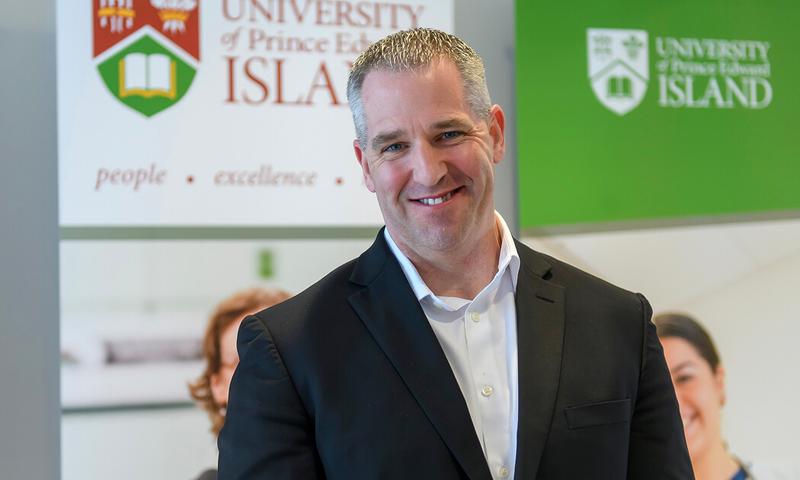
Paul Young was one of those who thought a medical school wasn’t possible – until he was hired to make it happen. Officially, Young is the school’s chief operating officer; he’s also employee number one.
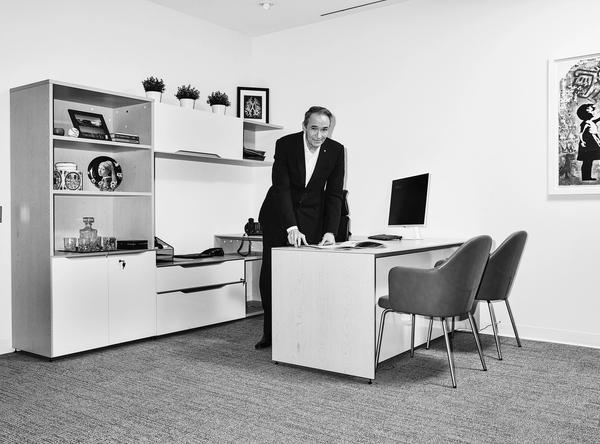
“I used to say that quite loudly … ‘Let’s do what we do well, expand our residency programs,’ and that’s probably the best we could ever do,” says Young, referring to the P.E.I. government’s purchasing of seats at other schools. He’s sitting in his fifth-floor office overlooking UPEI’s football field, with artwork and diplomas stacked neatly against the wall waiting to be hung up. Young spent a couple of decades working as a hospital administrator across Canada before returning to P.E.I. in 2008 to work at Community Hospital O’Leary in western P.E.I., where he “spent a lot of time borrowing and stealing physicians to keep the ER open.”
Eventually he moved to Prince County Hospital in Summerside, the second-largest hospital on the Island, where he thought things would be different. They weren’t. On a single weekend in 2021, he had to manage three near crises: the ICU was on the verge of closing for lack of internists; the operating room was compromised because there weren’t enough anesthetists; and the emergency department was at risk of shutting its doors. Again. All that, plus the pandemic.
So when the P.E.I. government announced funding for UPEI’s new medical school, Young found himself revisiting a lot of what he thought about medical training on the Island. “You get to really eat your own words,” he says, explaining that conversations with colleagues and friends helped shift his thinking to solving the problem at the front end: “When the opportunity came to jump in and participate more upstream, to develop the labour that we so desperately need, that was a call I couldn’t refuse. I was all in.”
P.E.I. had been actively recruiting doctors for years but found some were reluctant to move to an island without a medical school to anchor research, skills upgrades and the kind of professional community that makes a career sustainable. Aspiring medical students from the Island, beyond those who could nab one of those 11 reserved seats, were increasingly at a disadvantage, says Young, because “most medical schools are geared to their own provincial citizens, and then there’s a small portion that the rest of the country competes for.” Data shows Island students have the highest odds to overcome in Canada to access medical education: “It’s not that Island youth aren’t very talented and quite brilliant, but they’re competing with thousands of other Canadians for this very small number of seats.”
If P.E.I. couldn’t recruit its way out of the problem, and its young people couldn’t easily access other provinces’ education pipelines, it would have to build its own. The small team Young put together faced some formidable headwinds.
First, UPEI and Memorial University’s proposed joint degree program was something new for the Committee on Accreditation of Canadian Medical Schools (CACMS), the national accrediting body, which prefers identical curricula and assessments, and comparable learning environments. It’s essentially a franchise model, where the recipient university or campus hosts the medical school program, unchanged. (The University of New Brunswick’s Saint John campus, for example, hosts Dalhousie University’s program.)
UPEI wanted to do something more: to tailor its medical education to P.E.I.’s smaller health system and population, and build local research capacity. It also wanted to create the social capital and local pride that come with having its own medical school, not just a hosted campus.
The second challenge came from within. The provincial Medical Society worried that pulling doctors away from patient care to teach would strain a system already at its limits; it asked for the aggressive schedule to be paused to allow for consultation and better integration with Island doctors. Dr. Michael Gardam, then the CEO of Health P.E.I., which delivers all publicly funded health care in the province, echoed that concern. “We need to recognize that in order for the med school to be successful, Health P.E.I. has to be functioning,” he told the organization’s annual meeting in 2023. “We have to be better than we are now. Otherwise, I worry that this whole thing is going to fall apart.”
Young says it was a struggle early on. “Some days, success was literally just getting from Monday to Tuesday,” he says. “We knew we’d get to the finish line, but some days that was as far ahead as we could see.”
Finally, there was the construction itself: a $103-million, 138,000-square-foot building, including $30 million in advanced IT infrastructure. Contractors said it would take a minimum of 37 months to build; UPEI needed it done in 32, ready to welcome students in August 2025.
In the end, says Young, the very thing that caused early doubts turned out to be a help. “People said our size was the reason we couldn’t do this,” he says. “In reality, our size is the reason we could pull this off.”
The Island and its medical community were small enough that Young and his team were able to list from memory every physician in the province in a single whiteboard session – and then reach out to each of them for personal one-on-one chats at kids’ sports events, over coffee and in grocery store aisles. They listened to concerns and addressed them, and when the school put out its initial call for doctors willing to teach, it had a waitlist within 36 hours.
Additionally, more than 5,000 people responded to a call for folks willing to be trained as patients and bystanders in the simulation centre – like the worried caregiver paramedic Jessica Lake had to calm down. That’s about three per cent of the Island’s total population.

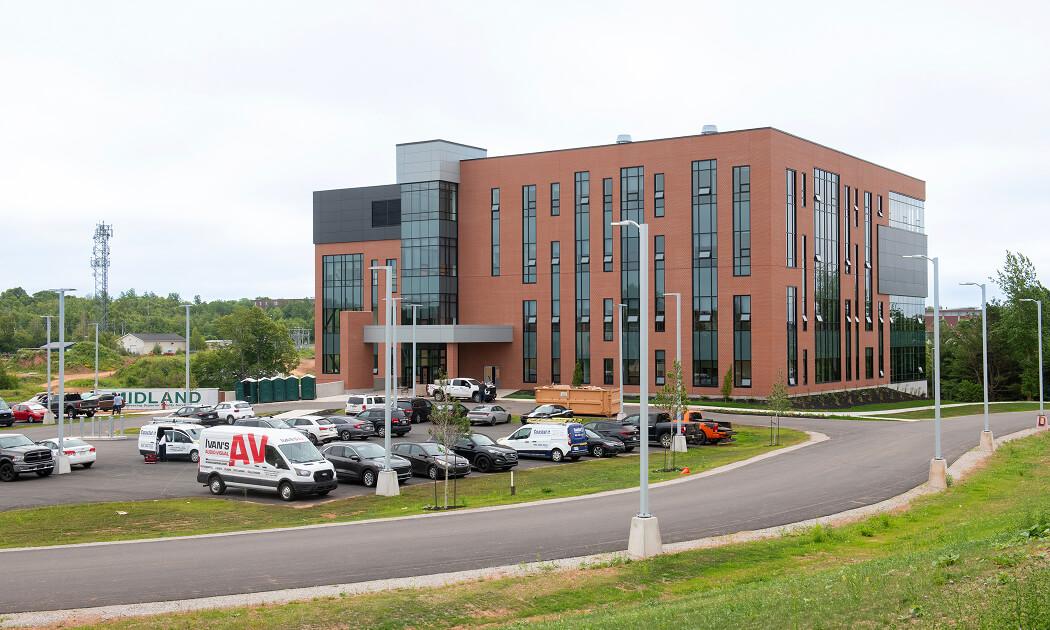
The Faculty of Medicine and Health Sciences Centre sits on the north end of UPEI’s Charlottetown campus, a few minutes’ walk from the main quad, across from a busy thoroughfare of big box stores and fast food restaurants. It may not be what you’d expect a medical school to look like: its first floor is home to family doctors’ offices, where regular people – moms with kids, senior citizens with walkers – receive treatment and where, on the upper floors, students and other medical professionals come to hone and upgrade their skills.
For Dr. Preston Smith, dean of the UPEI Faculty of Medicine, that’s the point: a medical school shouldn’t stand apart from its community; it should be the thread that stitches it all together. The P.E.I.-raised doctor practised medicine in Moncton, N.B., for 25 years, then switched to academia, helping to launch Dalhousie’s program in Saint John in 2010, and more recently led a restructuring of the University of Saskatchewan’s medical school. From that experience, Smith came to support a vision to train doctors who understand and value what it means to practise on a small island and who see themselves as stewards of that system, not simply workers within it.
Part of that is using Memorial’s existing strength in rural and family medicine to help UPEI build its own sustainable physician supply. Practically, that means Memorial continues to deliver much of the biomedical science content while helping UPEI layer onto that the pieces that are specific to P.E.I.: the daily workings of its health system, its social determinants of health and the leadership skills doctors will need to help change a system where thousands of residents lack a regular primary-care provider. (As of 2022, P.E.I. was the province with the highest percentage of residents, 24 per cent, without access to a regular health-care provider; the national average was 14 per cent.)
Smith’s thinking reflects a broader shift in how Canada is approaching primary care. In 2023, the Canadian Medical Association (CMA) called for 50 per cent of Canadians to have access to collaborative, team-based care by 2028. This replaces the solo family doctor with clinics where doctors, nurse practitioners, pharmacists, therapists and other health-care professionals come together to serve the full scope of patient needs. It’s considered better for patients – and for health-care workers by alleviating the stress of working alone, unconnected to other practitioners and specialists.
And by letting doctors do what they do best. “We need practitioners who are all practising at the top of their scope,” says Smith. “If an endocrinologist is writing insulin prescriptions for a stable Type 2 diabetic, that’s a system failure; an RN can do that, and if it’s what they do all the time, they may even do it better.” For family doctors, that means less time checking blood pressure and more time spent managing complexity, including patients with a variety of health-care challenges or patients with vague symptoms that aren’t easily diagnosed.
Physicians working in genuinely collaborative teams, with everyone co-ordinating, is simply the most efficient and effective way to deliver care. “They don’t all need to see the patient at the same time, but they do need to communicate about the patient,” says Smith.
What ties that team together isn’t the traditional medical hierarchy – it’s about peer relationships. “We ought to train the team so the patient feels like they have a relationship with the team,” says Smith. “Sometimes they’ll see a nurse, sometimes a doctor, sometimes another professional, but it all feels like one circle of care.”
And to do that, Smith has either hired or is looking to bring on faculty who are cross-appointed into other academic disciplines including nursing, nutrition, business and even veterinary medicine, the latter provided by UPEI’s Atlantic Veterinary College (which could mean better understanding of animal-human disease transmission, for example, like the spread of hantavirus on a cruise ship).
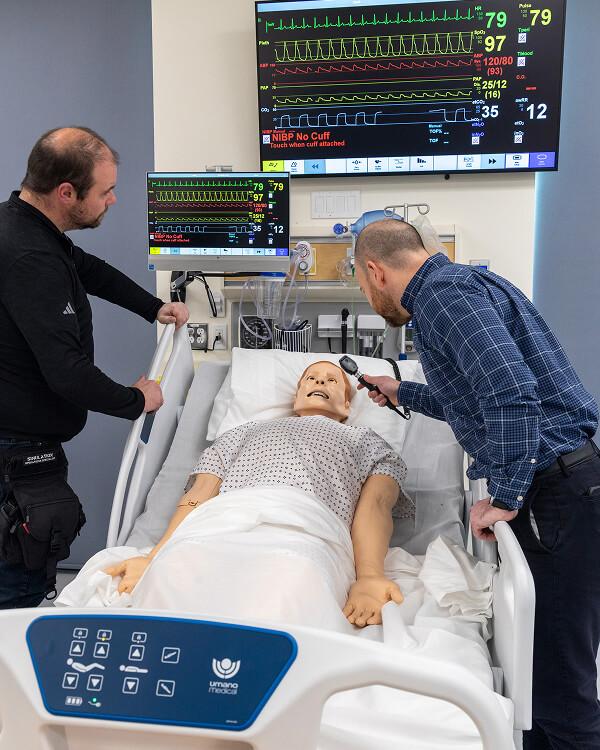
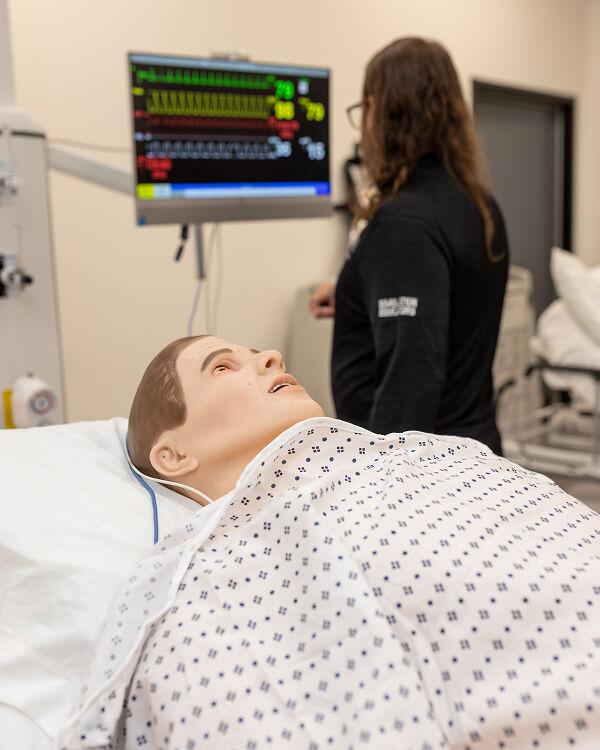
Down on the fourth floor, Tammie Muise is teaching students and health professionals how a circle of care works in real time.
Muise is a critical care nurse by training, having worked in ICU and emergency departments in Atlantic Canada, Maine and Hawaii, and one thing she’s learned over more than 20 years is this: you don’t become great at crisis care by reading about it.
So when she was offered the chance to design and lead the medical school’s Clinical Learning and Simulation Centre, she took off on a cross-country tour of best-in-class examples in medical schools and hospitals such as Alberta’s hospital system, St. Michael’s Hospital in downtown Toronto, McGill University in Montreal and Dalhousie University.
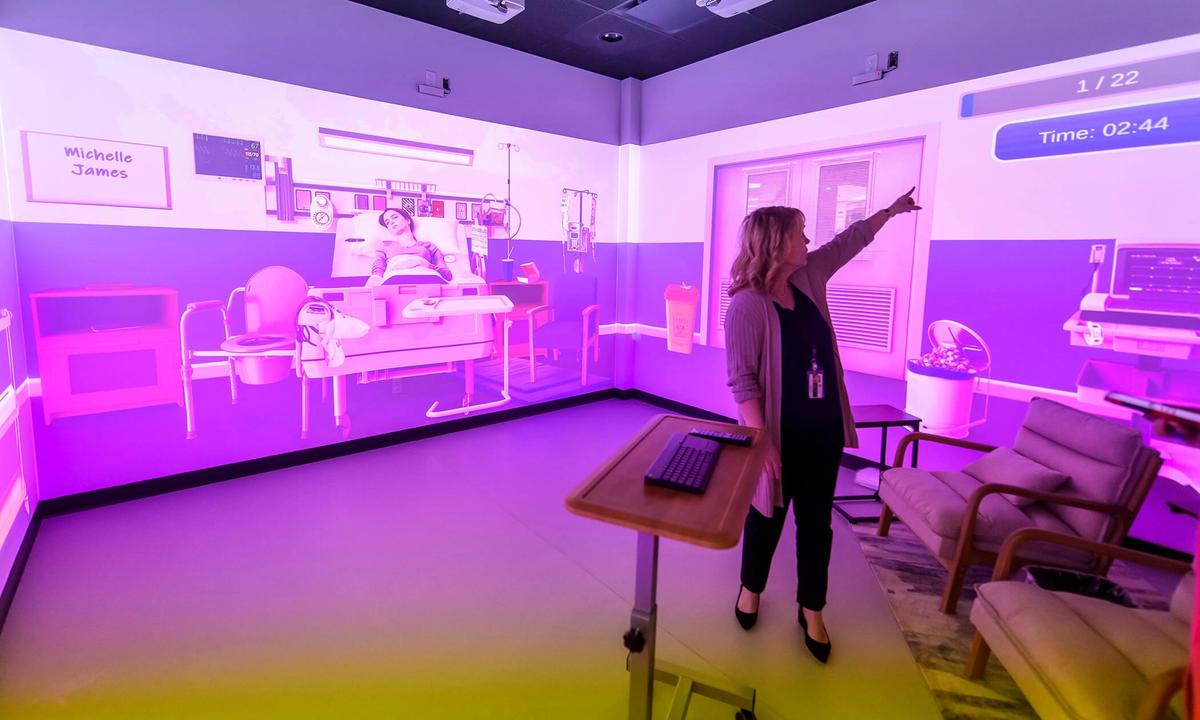
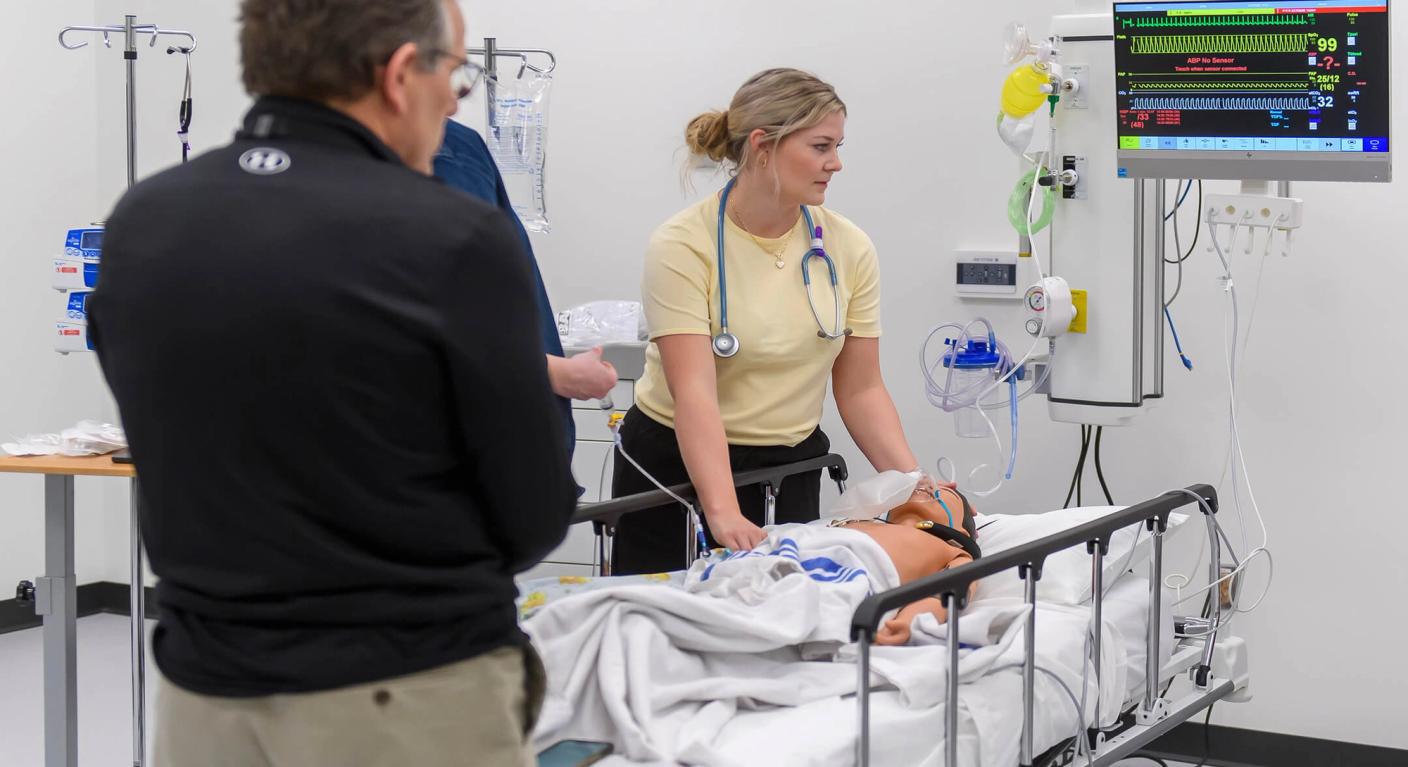
The result is possibly Canada’s most advanced simulation centre, one that includes a surgical skills room, 10 advanced simulation rooms, a fully equipped ambulance, two replica apartments with working stoves, open drawers and tripping hazards and an immersive augmented-reality learning space with sensory experiences of sight, sound, smell and touch. Operators are able to pipe in scents, for example, such as a pine forest, as well as fresh breezes, and to program temperature changes to simulate Canada’s four seasons.
“This is my favourite feature,” says Muise, running her hand along the slate grey countertop of the nurses’ station in the simulated hospital ward. “This is where a lot of action happens between the disciplines. This is where all kinds of crucial conversations happen, the collaboration.”
The mannequins they use can breathe, talk, urinate, cry and sweat. They can give birth. They range in age from infant to geriatric. The adult mannequins weigh about 150 pounds, so lifting one feels like lifting a real person.
A few are from 3D scans of real people, such as seven-year-old Gwen, a child mannequin with Down syndrome and narrow airways, modelled after the real-life Gwen who smiles out from a photo taped to the rolling table at the foot of a bed.
Each simulation space contains three elements: the sim space itself; a control room behind one-way glass where clinicians and technicians control the mannequins, making them react to learners’ actions; and a debrief room where students and instructors talk through what happened and what was learned.
In the first four months of 2026, more than 1,600 learners have entered Muise’s world, the smallest group being the 20 medical students. The vast majority have been working health practitioners, here to hone their skills and learn how to practise at the top of their scope.
In 2031, the first UPEI-trained physicians will receive their licences and, if the gamble holds, most will stay — doctors who trained here, began building their lives here and chose to stay.
The province that hosted the Confederation meetings in the 19th century is now trying to keep Canada’s most valued 20th-century promise into the next century: that no matter where you live, you can get the health care you need.
“This,” says Paul Young, “is our starting line.”