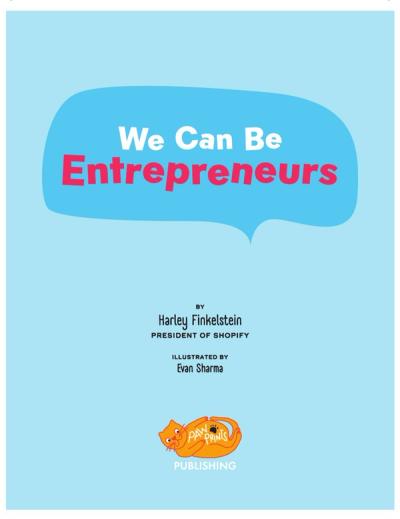
Your children’s book We Can Be Entrepreneurs was inspired, in part, by your own story as a pre-teen DJ. How did that set the stage for your future success?
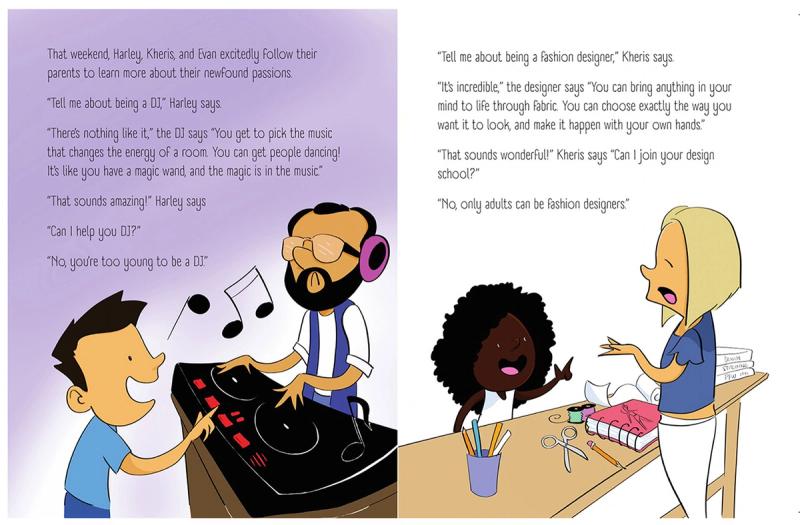
I was a creative, rambunctious kid. I couldn’t really sit still – maybe I still can’t. The only thing in the world I wanted to be was a DJ. My parents didn’t have a lot of money, I obviously didn’t know how to DJ and I probably looked like I was eight years old. When I told my dad, who was an immigrant, that’s what I wanted to do, he said, “Well, if no one will hire you, why don’t you start your own DJ company and hire yourself?”
He didn’t have seed capital to give me, but he came home with a business card that said, “Harley Finkelstein, DJ.” That one gesture changed my life. I learned how to DJ, found mentors, saved money from birthdays and odd jobs and ended up DJing something like 500 bar mitzvahs between the ages of 13 and 18. That was my introduction to entrepreneurship.
You say teachers need to stop asking kids what they want to be when they grow up. What’s wrong with that question?
There are two problems. First, it’s often presented as multiple choice: doctor, lawyer, accountant, firefighter, dancer. Entrepreneur is almost never on the list. We’re passively teaching kids that starting a business isn’t something they should be ambitious about.
But there’s also a problem with the question itself. “What do you want to be when you grow up?” assumes there’s some threshold, a certain age when you can finally start doing your thing or find your life’s work. I want kids to understand that they don’t have to wait until they’re a certain age or have a certain amount of money, education or skills. They can get started now. That’s what I wanted to convey with this book.
In some ways, it’s a Trojan horse. The story is an adventure about three friends who realize they don’t have to wait until they grow up to start building something. Hidden inside is a worldview: you can notice a problem, develop new skills, work with other people and make something of your own. You don’t need anyone’s permission to begin.
I’m not trying to turn every child into a CEO. I want kids to learn as early as possible that they’re allowed to have an idea and act on it.
My five-year-old currently wants to be a mermaid. Is it time to burst her bubble? Start spitballing startup ideas?
I would not mess with that at all. The point isn’t to redirect kids toward a business plan or monetize their childhood. It’s to protect the part of your daughter that believes she can imagine something and bring it to life. That’s the same muscle an entrepreneur uses. If she wants to be a mermaid, ask her, “What does the world you’re imagining look like? Can you draw the kingdom? Make a costume? Write a story? Put on a show?” Help her connect the idea in her head to something she can make in the real world – no pitch deck required.
Kids are natural entrepreneurs until we tell them not to be. Their minds default to yes; instead of why, it’s why not? That’s the mind of a founder. Then, right when their imaginations are bursting with possibility, we start setting limits. We give them prescribed answers and teach them to be afraid of getting things wrong.
What should schools be doing differently?
Entrepreneurship shouldn’t just become another course that ends with a multiple-choice test. Let kids build things. Give them real problems, small budgets, deadlines, teammates and even customers. Let them run a small business, organize an event or make a prototype. Let them hear “No,” revise something and try again. I think of it as physical education for ambition. Every student should leave school having built, launched, sold or organized something real – not because every kid should start a company but because everyone should know how to turn an idea into action.
Entrepreneurship is a gamble. Does your message apply to lower-income kids and families who may feel like they can’t afford the risk?
We absolutely shouldn’t tell a child without a financial safety net to make a reckless bet. But I’d flip the premise. Entrepreneurship has often been the path for people who were never given certainty in the first place. My grandfather arrived in Montreal as a refugee with absolutely nothing. Within a week, he figured out a way to open a small egg stand at Jean-Talon Market, and he ran it for 60 years. That wasn’t a luxury choice. It was survival. He had no money, no education and barely spoke the language. Millions of Canadian families have some version of that story: a corner store, a dry cleaner, a restaurant. They just didn’t use this interesting word “entrepreneur.”
He wasn’t calling it an egg startup?
Exactly. He wasn’t writing a blog post about 10 ways to increase his growth velocity or his free-cash-flow margins. It was survival. I experienced a version of that myself. When I was 17, I was a first-year student at McGill. Things got really bad for my family. My dad wasn’t around, we lost everything and I had to support not only myself but my mother and two younger sisters. Once again, I pulled this tool called entrepreneurship out of my tool belt. I started a T-shirt business making shirts for universities across Canada. It allowed me to finish my education and help my mom with rent and my sisters with school, books and summer camp.
Entrepreneurship doesn’t care where you were born, who your parents are or what your last name is. It cares whether you can create something of value that someone will pay for.
You’ve said we may be entering a “golden age of entrepreneurship.” That might surprise parents who are watching AI upend the job market and wondering what work will even look like by the time their kids graduate.
I gave the convocation speech at McGill this year, and what struck me was how much trepidation students had around AI. And I understand it. The fourth-year management students entered university with this premise: “I’m going to get this piece of paper and get a great job.” Four years later, the world had shifted. Of course that’s scary, but uncertainty has always existed. I started McGill in 2001 around the tech bubble. I graduated law school in 2008 during the financial crisis. I was helping run Shopify during COVID. Throughout history, there’s always been uncertainty about what comes next.
The antidote is the ability to build something on your own, to survive on your own, to look at a problem and see an opportunity. AI, in my worldview, is an accelerator for human ambition and human skills. It allows us to go faster.
Entrepreneurship in Canada has fallen dramatically over the past couple of decades. What happened to our entrepreneurial mojo?
Canada was shaped by generations of audacious entrepreneurial immigrants who came here with no guarantees and built anyway. Two generations ago, when my grandfather arrived, that audacity was closer to our default. Somewhere along the way, we became comfortable. We started telling ourselves a smaller story. We should all be concerned about the decline in entrepreneurship. But the desire is still there. For every new entrepreneur we create in Canada, there are more than 100 aspiring entrepreneurs who say they want to take that leap. They don’t lack ideas; some lack conviction. If we can give kids that conviction at nine instead of hoping they find it at 39, I think Canada can become a founder nation again.
Get our weekly newsletter – the people, places, and ideas revealing where Canada is headed.
You’re prime minister for the day. What changes would you make to encourage an entrepreneurial spirit in the next gen?
Can I have three?
Sure.
First, give every child practical entrepreneurial experience in school: a tiny budget, basic tools, a mentor and the opportunity to take an idea from nothing to something.
Second, make the first attempt easier. Young people should be able to start something, open the right bank accounts, access small amounts of capital and sell across provincial lines without needing a lawyer to navigate the process. And those opportunities should be especially accessible to lower-income kids, rural kids and newcomers, because talent is everywhere but networks and resources aren’t.
Third, we need to tell a better story about who we are. We’ve spent a long time describing Canadians as polite, humble and cautious. I love that, but our history says we’re also quite audacious. Government can’t manufacture audacity, but it can celebrate it, widen access and stop putting unnecessary barriers in people’s way. The goal isn’t for government to pick nine-year-old winners. It’s to make sure every child has permission and a fair opportunity to get started.

Parenting culture these days feels very focused on minimizing risk and controlling outcomes. We’re obsessed with protecting kids from failure and disappointment, which seems antithetical to raising entrepreneurs. Any tips on pushing back?
Lindsay and I let our kids try small things and let some of those things fail. Nobody learns to handle uncertainty by reading about it. A nine-year-old who sets up a lemonade stand, sells nothing the first day, changes something and comes back the next day has learned more about risk than any lecture could teach. As long as the stakes are small, childhood is the perfect place to practise. The mistake I’ve made sometimes is protecting my kids from every small failure and then wondering why they’re terrified of the big ones.
A failed weekend project is not a failed child. The business may not survive, but the learning absolutely does. The calm comes from discovering: “I tried something. It didn’t work. I was still okay. Now I can adjust and try again.”
My kids once decided that instead of a lemonade stand, they were going to sell hot chocolate in the middle of a Montreal snowstorm. I thought, “No one is going to stop.” But I said, “Put on your snowsuits and try it.” They came back and said, “Yeah, no one stopped.”
And what did you say?
“Maybe tomorrow will be nicer. Or maybe you offer curbside service so people don’t even have to get out of their cars.” These types of conversations are not just, you know, silly things we talk about before bed at night. They actually help shape their understanding of the world and business and entrepreneurship and finding a life’s work, which is not something my grandfather ever had nomenclature to describe.
He was too busy running his egg startup.
Exactly. Entrepreneurship under a different brand.