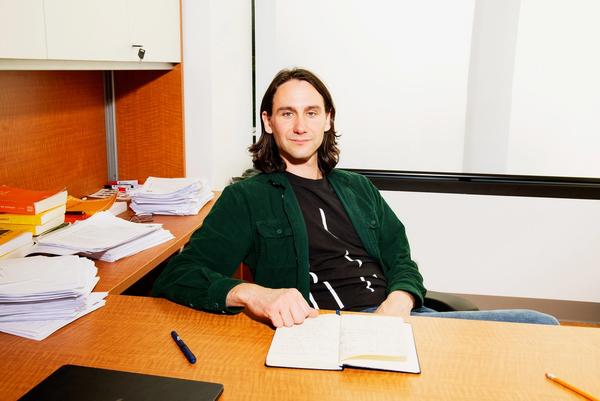
It’s a beautiful sunny afternoon in early October and Alfred Burgesson is onstage at a Toronto conference centre warning a crowd of policymakers and business leaders about the toll AI is about to take on their workforce.
His tone is good-natured but firm. “The frontier labs have put out research saying there’s 75 per cent [AI] exposure for certain occupations. Quite honestly, it pisses me off when I see that stuff,” he says. “We’re putting out this macroeconomic information without providing any nuance to Johnny and Susie and what it means for their jobs.”
Burgesson is a 30-year-old entrepreneur, community organizer and self-described builder, and he‘s speaking at an annual forum held by the Future Skills Centre, a research centre focused on the future of work. This event is aimed at “building resilient talent pipelines,” policy-speak for ensuring that employers have access to a workforce with the skills they need and that workers have access to quality jobs. Burgesson is introducing the final conversation of the day, on what may be the biggest labour bogeyman of them all: AI exposure, the measure of how much a specific role can be automated, augmented or otherwise transformed by artificial intelligence. It’s a topic he’s spent a lot of time thinking about; Burgesson recently spent eight months as senior adviser to Evan Solomon, Canada’s minister of artificial intelligence and digital innovation. He left that role convinced that, despite their best efforts, neither government nor industry is equipped to respond to the immediate needs of everyday Canadians as they navigate AI’s impact on their jobs.

Alfred Burgesson doesn’t think government is agile enough to solve this problem. “What we need to do is actually empower people to have the ability to keep up with AI.”
A Research Co. poll from back in September found that 82 per cent of Canadians are concerned about job losses due to the technology, while 62 per cent worry that AI will negatively affect them or a loved one. At the same time, AI usage is on the rise, with nearly half of Canadians reporting they’ve used a generative AI tool at least once in the past year, up from 33 per cent in 2025 and 16 per cent in 2024. While AI adoption in Canadian workplaces remains limited (only eight per cent of business leaders say their companies use AI to a significant degree), the Bank of Canada’s 2025 Business Leaders’ Pulse survey found that nearly 40 per cent of Canadian businesses plan to increase capital spending on the technology in the next three years.
“If employees are being forced to use this tool without understanding how that exposure risk impacts their job right now and how employers are going to create strategies to mitigate risk, then those survival instincts will come into play and they’re going to fight back,” says Burgesson.
He doesn’t think government is agile enough to solve this problem. “What we need to do is actually empower people to have the ability to keep up with AI,” he says. “We talk about creating a new social contract or [say that] new institutions are required. Well, who’s doing it?”

Get our new book for free.
Subscribe to our newsletter and we’ll mail you a printed copy.
By now, it may be obvious: he’s going to try. Burgesson’s next project is From the Ground Up, a recently launched platform that aims to connect working Canadians with clear information about how this technology is affecting their industries and provide them with real opportunities to shape AI use and implementation.
Burgesson knows well the benefit of making ambitious plans to tackle tough challenges. When he was six, his family moved from Ghana to Port Hawkesbury, a rural town of 3,000 people on Cape Breton Island, N.S., in search of better opportunities. His dad, Alexander, had served in the Ghanaian navy before working as a chief engineer for companies in Germany, France, China and Singapore; his mother, Juliana, was a public servant. Burgesson, the youngest of three children, often tells the story of leaving Ghana with his mother and siblings, excited to meet his dad in Canada, where he’d been working for a year already. “When we were coming to Canada, my mom literally looked at me and said, ‘This is not a vacation.’”
His parents would have to go back to school in Canada, and the family of five would be downsizing to a two-bedroom apartment. They were moving to a town with fewer than 100 non-white residents, and his father told him there was a possibility people would see them as lesser than. But appearances didn’t matter. Achievement did.
The message, he says, was, “‘Yeah, we’re going to take two steps back, but we’re being intentional.’ It felt like we were on a mission, and all of us kind of just stayed focused on that mission, which was to definitely make something of ourselves.” The goal was never to make a lot of money, he adds, but to “be a good person, have a positive impact and solve problems if you can.”
In high school, Burgesson became involved in Junior Achievement, a youth non-profit that teaches students about financial literacy, helps them prepare for their future careers and introduces them to entrepreneurship by allowing them to brainstorm and run their own business. It was his first taste of “iterate and adapt” – and it was exciting. Even in this introductory form, entrepreneurship allowed Burgesson to identify a challenge and move quickly to solve it.

Burgesson as a child.

Burgesson‘s parents.

Burgesson‘s childhood Ghanaian passport.

Burgesson‘s father.
He enrolled in the commerce program at Saint Mary’s University in Halifax but soon switched to political science and entrepreneurship. It was his side hustle that really helped him find his path. Burgesson ran a social media marketing company called Under the Bridge Digital Media with a friend, which provided a practical counterpoint to the theory he was learning in the classroom. When he took on freelance project management and youth work for the Assembly of First Nations, he again found himself comparing what he’d observed in meetings with Indigenous chiefs and leaders to what he was hearing in lectures.
“I remember the sense of empowerment they had,” he recalls. “They’re trying to right some wrongs and they’re 10 toes down speaking to ministers, telling them, ‘This is what you have to do.’” The chiefs weren’t combative or disrespectful, but they were uncompromising, which has shaped Burgesson’s own approach ever since.
His first big post-graduation venture was Tribe Network, a not-for-profit organization that provides coaching, networking opportunities and investment capital to Black, Indigenous and other racialized entrepreneurs in Halifax. Tribe grew out of a stint Burgesson had done in Nova Scotia Sen. Colin Deacon’s office, where he spent a year interviewing Black entrepreneurs about the barriers and opportunities they faced. The resulting survey found common problems across the country: “systemic racism, limited access to capital and insufficient business networks.”
Just collecting the information wasn’t enough – Burgesson wanted to “do something with this knowledge,” he says. So at Tribe, he designed programs that gave Black and Indigenous founders opportunities to build market-ready businesses with coaching and mentorship from longtime entrepreneurs.
Eventually, the company launched its own venture capital fund – the $20-million Tribe Ventures – alongside three other executives (Savior Joseph, Phillip Yoon and Mehad ul Haque), which focused on pre-seed and seed-stage companies with racialized founders. Joseph had been a senior executive in the cannabis industry; Burgesson had met him a decade before, when he was an aspiring entrepreneur looking for advice from a more seasoned business leader. Joseph became Tribe Network’s founding board chair.
“Alfred has always had a unique ability to build allies and to build trust,” says Joseph – even in spaces where he’s a minority due to his age or ethnicity, and even when he’s speaking firmly about the real-life impacts of oppression and marginalization. Joseph likens Burgesson to a young Barack Obama in his ability to move through community spaces and the halls of power with equal ease.

“I don’t think you need to be an AI expert to shape what this thing is evolving into. We need people who are willing to take action in a productive way.”
Burgesson’s goal, when he then moved into those halls of power himself, was to help make sure historically marginalized communities didn’t get left behind in the AI revolution. He describes his experience in the Ministry of Artificial Intelligence and Digital Innovation – which came via a connection with former diplomat Marc-André Blanchard, now Prime Minister Mark Carney’s chief of staff – as brief and disorienting, though he says he’d do it again. The principal frustration was that although the sheer pace of AI innovation was overwhelming, and he knew people were worried about how it would affect their jobs and lives, the process of actually creating policy to address those challenges was grindingly slow.
“I'm used to drawing up the play and having the resources to do the thing. ‘If we want to do it, if we think this is the right move, let’s do it,‘” says Burgesson. “Whereas in government, you’re dealing with a lot of other people, processes, power and priorities.”
AI for All, the federal government’s national artificial intelligence strategy, which Carney announced in June, focuses on boosting corporate AI adoption to 60 per cent by 2034 and creating 250,000 new jobs. But Burgesson says it doesn’t necessarily address the worries of everyday Canadians, the Johnnies and Susies of his Future Skills Centre talk.
That’s the next solution he’s working on.
From the Ground Up is meant to be an online gathering place for a politically engaged subset of young people who want more of a say in how AI gets implemented but who don’t have the ear of politicians or business leaders or access to one of the country’s three national AI Institutes: Edmonton’s Amii, Montreal’s Mila and Toronto’s Vector Institute. Instead, the platform allows anyone to find collaborators with complementary skill sets who can contribute to AI-related projects, whether that’s running a community-led consultation project on a proposed data centre, a research project measuring employment gaps among specific demographics or building a workplace intelligence tool that measures AI job displacement.

Burgesson has already done some work on that last bit. He’s developed a tool called Netwell.ai to help workers understand how their specific roles may be affected by AI adoption now and in the near future. It uses publicly available data from the Canadian and American governments on specific jobs, then it maps that information against Anthropic’s economic index to develop a baseline understanding of AI exposure. Users fill out a questionnaire about their own day-to-day tasks and disclose where they are in their careers, which helps the tool make an individual assessment. At the end, it delivers a personalized exposure score. (For a journalist who’s been in the industry for 15-plus years, the outlook is that “AI is likely to significantly change how your work gets done over the next 12 to 24 months,” which is higher than 98 per cent of the occupations it scores – oof – though it does, somewhat reassuringly, note that a lot of this work can’t currently be done by AI.)
Netwell.ai is a registered non-profit, while From the Ground Up is a social enterprise. “The goal isn’t to maximize shareholder value, but to focus on social impact and reinvesting benefits back into the cause,” Burgesson says, noting the platform will generate revenue through a mixture of grants, new ventures that he and his team launch through the platform and providing strategy and advisory services to clients.
He acknowledges that his current work shares limitations with government approaches, including the simple fact that offering people a better sense of what’s coming does not, in fact, prevent it from arriving. And even if it helps workers better understand their circumstances so they can take steps to prepare, they’ll still need to figure out what those steps are on their own.
But if current institutions move too slowly to keep up with the godlike power of AI, he says, perhaps he can build a new type of institution that’s better prepared to respond and incorporates more people’s perspectives.
With Netwell.ai specifically and From the Ground Up broadly, the onus is on users to clearly communicate their goals, identify the skills they need and take their ideas beyond simply talking about them; From the Ground Up isn’t meant to help these collaborators organize public consultations or take community feedback to their local governments, for example. Instead, Burgesson is betting on the value of simply offering people a framework to collaborate. “I don’t think you need to be an AI expert to shape what this thing is evolving into. We need people who are willing to take action in a productive way.”